Insulation; where to begin?
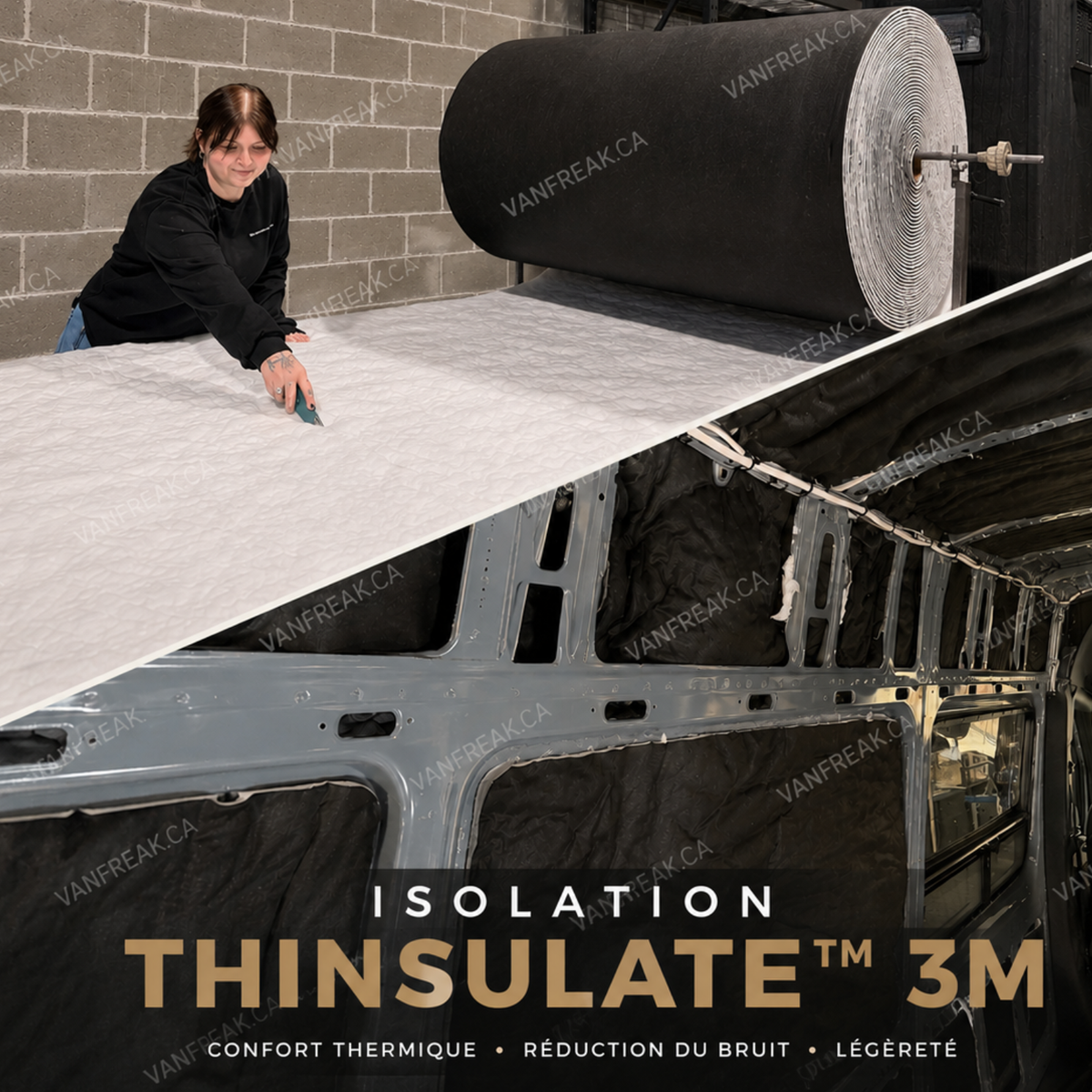
ISOLATION
It is essential to insulate your vehicle for all temperatures. We often hear "I won't use my vehicle in winter," but it is crucial to insulate for summer temperatures, especially since this is usually the most frequent period we go camping with our van, despite the fact that more and more van are being used in winter.
Insulation is often seen as protection against the cold, but it's just as important, if not more so, for heat. Otherwise, you won't be able to sleep well in your van, and it will be often too hot, and not comfortable .
What you should have;
- A thermal barrier ( Thinsulate is an excellent choice)
- A material that will maintain a constant temperature as much as possible: Insulation
- A vapor barrier (which allows the van to breathe, and regulate humidity )
1 - The thermal barrier will precisely create a barrier (a break) between hot and cold, preventing most of the temperature from entering our van. In summer, we want to keep the heat outside and prevent it from getting in the metal walls of our van as much as possible. In winter, we understand that we want to keep the cold out of our wall.
2 - Insulating materials are those that can trap ambient air and keep it longer at the desired temperature. When you turn on the heat in winter, an insulation material will retain this heat longer from inside, thus requiring less heating. In summer, the coolness provided by ventilation or air-conditioning will be retained longer in a material with insulating properties.

A good insulation will be able to maintain comfort longer. Natural fibers also have a bit higher retention capacity than the rock fiber panel .
Using Thinsulate solely as insulation?

3M Thinsulate - SM600L is primarily a sound-absorbing material used in the automotive industry. Due to its weave of polyester and polypropylene fibers, it also has an R-value (R=5.2),
THINSULATE™ SM600L offers excellent sound absorption and significantly reduces reverberation and interior noise inside your vehicle.
It absorbs airborne sound frequencies (ambient noise), making it the #1 choice for acoustic insulation in a single product.
. Using a vapor barrier is also recommended when using Thinsulate alone to prevent excessive moisture from getting in the walls.
2.1- Should I add an Anti-vibration Material ?
Products such as Kilmat are primarily recommended for commercial vehicles that will not be insulated with Thinsulate™ or another insulation material on the interior walls.
In these applications, the purpose of the anti-vibration material is to reduce the drum effect ( this is also the job of the thinsulate) and panel vibration created by the vehicle's metal cargo walls, when those van will stay as is.
3 - The vapor barrier has a very specific function: it acts as a breathable membrane in the event of high internal humidity and as a vapor-retarder in the event of normal humidity. It is ideal for energy-efficient rebuild thanks to its adaptation to the hygrometric conditions of the materials, thus preventing the accumulation of moisture that could cause condensation and/or corrosion.
A good adhesive tape will hold it in place

Do not use plastic cover as a vapor barrier
A good vapor barrier would have breathable properties, unlike a plastic vapor barrier. The plastic will trap moisture on its surface, potentially causing the accumulation of humidity and water droplets.
You're going to create a lot of humidity in your van, and we want to be able to get rid of the water vapor as quickly as possible. Good ventilation is therefore, essential.
What to avoid
- Create a waterproof "sandwich" inside your walls; That is to say, stick a plastic material directly onto the sheet metal of the vehicle, put insulation and finish with another waterproof material, because this will have the effect of changing the air trapped in your walls by fine water droplets with temperature variations and this humidity will have nowhere to escape.
- We avoid all petroleum-based products (such as Styrofoam) which can cause friction. Unwanted noises that will be heard through grinding and/or emmiting VOCs
- We also avoid pink mineral fiber wool (which loses all its properties if it comes into contact with water)
Natural fibers are preferred .
Rock wool and Natural Fiber panels are excellent products that are easy to work with.
*Natural Fiber is much less irritating, rodent-proof and has a greater heat retention capacity than rock wool.
*Rock wool (in pad form) will be a bit more irritating to handle during installation because it's made of pulverized rock, so it's like rubbing yourself with very fine sand. However, rigid rock wool floor panels are easy to install.
With particular attention;
Are you considering spray foam (urethane) insulation? This type of insulation must be installed by professionals; otherwise, the vans's structure can easily be damaged by the excessive heat generated during application, causing the metal to warp. It's a chemical product, but although inert when dry, it's ultimately up to you to decide if this product is right for you. However, it's very difficult to remove if you need to access the van's body to add or modify openings, or if you've run electrical wiring behind it.
In conclusion;
It's important to remember that a van can't be insulated like a house, because you don't have 2x6 studs spaced at regular 16-inch intervals. You have to work with varying depths and widths along the length of each van. Therefore, you'll need to insulate differently depending on the area of your truck.
Your truck = your choices?
With all the information gathered on insulation, you can now begin the work according to your choice of materials. You will quickly have a major step forward in the beginning of your conversion.
Good insulation!
-Team Sprinterfreak
Reproduction for personal or commercial purposes is prohibited without the author's permission.